Key takeaway
Trace three centuries of Azerbaijani identity through Baku's streets — from medieval caravanserais to Soviet civic halls and the iconic Flame Towers. A walking tour of three eras with anchor buildings and history.
Baku is one of those cities that rewards slow walking. In a single afternoon you can pass medieval stone walls, 1950s panel housing, and a glass skyscraper shaped like three rising flames — each one representing a different chapter of Azerbaijani identity. Whether you arrive on a tourist visa or a business visa for Azerbaijan, a short architecture walk is one of the most rewarding things to do once you land.
Start your walk at the gates of the Old City (İçərişəhər). From here you can cover three centuries of built history in a loop of roughly four kilometres. The route runs through the medieval core, out along Soviet-era boulevards, and finishes at the base of Baku's most recognisable modern symbol. Most visitors apply for their visa through azerbaijan-visa.com/order-now before they arrive, which frees them to spend their time on the street rather than in bureaucratic queues.
The Old City: Medieval Walls and Persian Flair
The Old City dates to the 12th century and is a UNESCO World Heritage Site. Its outer walls, rebuilt several times, still encircle a district of narrow lanes, old mosques, and merchant houses that once made Baku a stop on the Silk Road.
The Palace of the Shirvanshahs is the anchor building of the medieval section. Built between the 13th and 16th centuries, it sits on a hillside and includes the main hall, the Divankhane (a reception chamber), royal baths, and the UNESCO-listed Maiden Tower. The palace complex mixes Islamic geometric decoration with local stone construction — you can see how builders adapted Persian architectural vocabulary to Caspian Sea geology.
Walk south from the palace toward Azerbaijan Avenue and you will pass several caravanserais. These were roadside inns where Silk Road merchants unloaded goods, rested, and traded. The Bukhara Caravanserai and Mugham Cultural Centre, housed in a restored historic structure nearby, give a sense of how commerce and culture coexisted in the medieval city.
Soviet Baku: Grand Plans and Panel Buildings
Exit the Old City through any of its northern gates and you step directly into Soviet Baku. After Azerbaijan's incorporation into the USSR in 1920, the city received a major civic overhaul. Architects imported modernist principles and blended them with national motifs — geometric patterns, arched colonnades, and decorative tilework referencing Azerbaijani carpet designs.
Istiqlaliyyat Street runs northwest from the Old City's Fountain Square and is one of the best-preserved stretches of Soviet civic architecture in the city. The buildings here include the former Council of Ministers headquarters, the Azerbaijan State Philharmonic Hall, and several administrative blocks from the 1940s–1960s. Notice the consistent cornice heights and the use of limestone rather than brick — a local material choice that softens the otherwise rigid modernist forms.
Further east along Azadlıq Avenue (formerly Lenin Avenue), the Soviet period shows a different face: large panel apartment blocks from the 1960s–80s. These karayachka buildings — named for their yellow-grey colour — housed Baku's expanding oil-industry workforce. They are utilitarian and unpretty by tourist standards, but they tell an honest story of mid-century urbanisation.
The Flame Towers: Modern Ambition on the Horizon
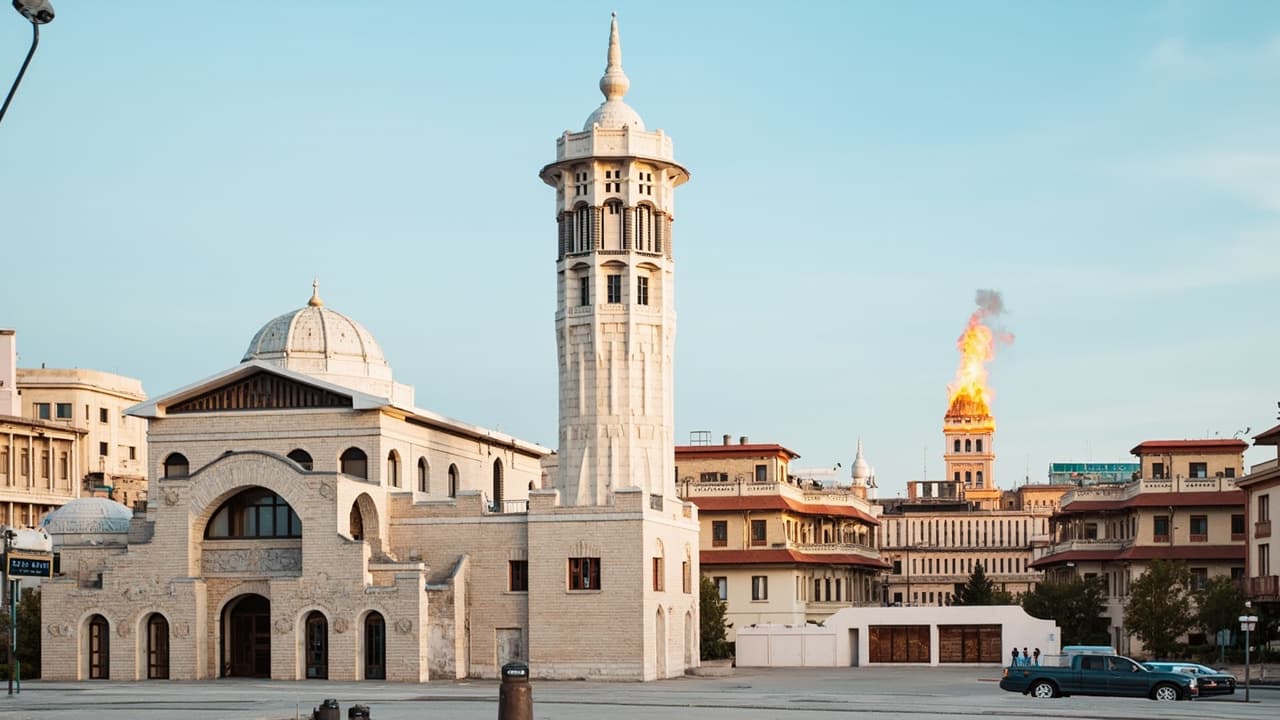
Cross the National Flag Square and walk north along the waterfront toward the business district. On the hillside above you, three towers of tinted glass rise 140 metres — the Flame Towers, completed in 2012. The shape of each tower flares upward at its peak, referencing the ancient Zoroastrian fire worship that gave Azerbaijan its name (Azar meaning "fire" in Persian) and the oil wells that made Baku rich.
The three towers house residential apartments, office space, and the Fairmont Baku hotel. The development replaced Soviet-era military facilities and marked a deliberate turn toward Gulf-state-style luxury real estate. On a clear day, the towers are visible from most of central Baku. The best vantage points are:
- Fountain Square, for a classic city-centre backdrop
- Azadlıq Square (National Flag Square), for a waterfront angle
- Flame Towers observation deck, for a direct interior view (book tickets in advance)
Other Modern Landmarks Worth Adding
Baku's architectural renaissance did not stop with the Flame Towers. Two other buildings are worth detours on the same walk:
The Heydar Aliyev Centre, designed by Zaha Hadid and opened in 2012, sits about 5 km north of the Old City but is easily reached by metro or taxi. Its flowing white surface has no sharp corners — Hadid described the design as a direct response to Baku's Soviet-era rigidity. Inside you will find rotating exhibitions of contemporary Azerbaijani art. The building's exterior has become one of the most photographed structures in the Caucasus.
The Azerbaijan National Museum of Art (Milli İncəsənət Muzeyi) occupies a former merchant's house near the Fountain Square end of Azerbaijan Avenue. Its collection spans Azerbaijani, Russian, and European art from the medieval period to the present. The building itself — a blend of late 19th-century European and local influences — is worth a close look before you step inside.
If you have time, continue to the Carpet Museum near the waterfront. Its building is shaped like a rolled carpet — an architectural joke that lands well in person. The permanent collection explains the techniques and regional styles of Azerbaijani carpet weaving.
FAQ
Is the Baku architecture walk self-guided?
Yes. The Old City is compact and easy to navigate on foot or with a smartphone map. For the Soviet-era district and Flame Towers, a self-guided walk is also straightforward — all areas are well-signed and connected by flat pavement along the waterfront. Guided group tours are available through Baku-based operators if you prefer a historian's commentary.
How long does a full Baku architecture walk take?
A complete walk covering the Old City, Istiqlaliyyat Street, National Flag Square, and the Flame Towers takes 3–5 hours depending on how long you spend inside buildings and museums. Split it over two half-days if you want to include the Heydar Aliyev Centre.
Do I need a tour guide for the Old City?
Not necessarily, but a guide adds context at the Palace of the Shirvanshahs and the Maiden Tower. Audio guides are available at the palace entrance for around AZN 5–8. If you are short on time, a 2-hour guided Old City tour is a good option.
What is the best time of year to do a Baku walking tour?
Late spring (May–June) and early autumn (September–October) offer comfortable temperatures of 18–25°C and lower humidity. Summer can exceed 35°C, making outdoor walking uncomfortable. Winter is cold (0–8°C) but the indoor museums are less crowded.
How do I get to Baku?
Baku Heydar Aliyev International Airport (GYD) receives direct flights from Istanbul, Dubai, Moscow, London, and several European hubs. Apply for your visa online before departure — most nationalities are eligible for the Azerbaijan e-visa, processed through azerbaijan-visa.com/order-now in standard or urgent tiers.
Are the Flame Towers open to visitors?
The towers themselves are primarily residential and office buildings, but the Fairmont Baku hotel lobby and restaurant are open to non-guests. The observation deck (Baku Eye) on the adjacent AZERBAIJAN Tower offers panoramic views. Check current opening hours before visiting, as access policies can change.
Key Takeaways
- Baku's Old City (İçərişəhər) preserves a medieval core of caravanserais, palaces, and baths that reflects Persian and Silk Road design traditions.
- Soviet-era buildings along Istiqlaliyyat Street and Azadlıq Avenue showcase mid-20th-century civic architecture with Azerbaijani decorative motifs.
- The Flame Towers define Baku's modern identity and are best viewed from Fountain Square or the National Flag Square waterfront.
- A complete architecture walk takes 3–5 hours and covers roughly 4 km — comfortable shoes and water are essential in summer.
- Combine your walk with visits to the Heydar Aliyev Centre, Carpet Museum, and Azerbaijan National Museum of Art for the full picture of Azerbaijani visual culture.
Azerbaijan Visa Editorial
Writes about Azerbaijan eVisa requirements, traveler tips, and fastest processing routes for visa applicants.
Ready to apply?
Start your Azerbaijan eVisa application now.